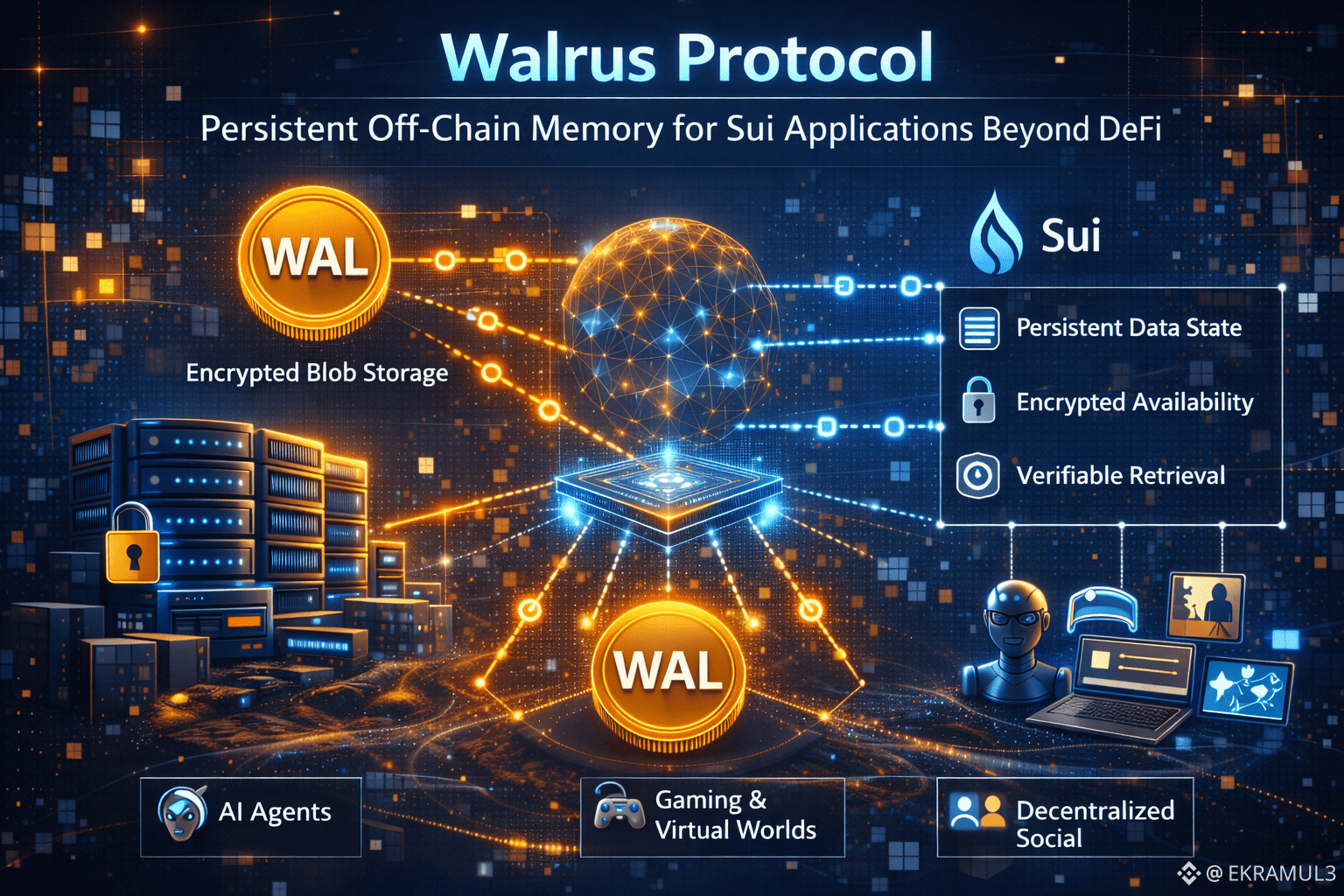
 When layer-1 blockchains first arrived, execution throughput was the bottleneck. If a chain could not process transactions quickly, everything else collapsed on top of it. Sui pushed that ceiling significantly higher with parallel execution, object-centric state, and low-latency finality. But as developers began building richer applications on Sui AI agents, media platforms, gaming worlds, and social systems another constraint emerged quietly underneath: data persistence.
DeFi never stressed this part of the stack. Tokens, positions, and swaps produce relatively small state transitions. They do not require storing gigabytes of application assets, evolving datasets, or user-generated media. But the moment applications shift toward social graphs, AI memory, or creator-driven content, execution is no longer enough. The chain needs a memory layer, not just a compute layer.
This is where Walrus enters the picture not as an IPFS alternative, not as a niche storage network, but as an off-chain persistent memory layer that Sui apps can program directly.
Why Persistence Cannot Live On-Chain
Putting everything on the base chain fails for three structural reasons:
1. Cost scaling is non-linear
On-chain storage grows indefinitely. Pricing must be punitive to avoid state explosion.
2. Latency breaks determinism
Fetching large payloads during execution would stall validators and kill throughput guarantees.
3. Privacy cannot be enforced
User data, ML embeddings, business logic, and media assets often require encryption and controlled access.
DeFi could ignore these constraints. AI-native and social-native applications cannot.
Walrus Reframes Storage as Programmable Off-Chain State
Walrus doesn’t treat data as static files. It treats it as memory that applications can reference, renew, revoke, gate, and price via Sui contracts.
When a developer uploads an asset:
Walrus encodes it using erasure coding
distributes fragments across independent nodes
stores cryptographic references on Sui
and exposes a programmable interface for retrieval rights
This creates three properties DeFi never needed:
✔ Persistence (data survives time)
✔ Availability (data survives failures)
✔ Verifiability (data survives distrust)
Why Sui Specifically Needs This Layer
Sui’s execution engine is extremely fast, but it assumes that developers do not overburden on-chain state with unbounded growth. Without an external persistence layer, developers are forced into bad tradeoffs:
❌ outsource storage to Web2 → breaks sovereignty
❌ shrink use-cases to fit chain limits → kills ambition
❌ push data to gateways → introduces trust & censorship
❌ strip features (social, media, AI) → reduces UX
Walrus fixes the missing piece: durable off-chain state that behaves like on-chain resources.
The Breakthrough Is That Walrus Makes Persistence Economic
The protocol introduces time-bound leases for data. Instead of pretending data is permanent forever, Walrus asks:
“Who is paying for this data to persist, and for how long?”
This pricing model aligns incentives with reality:
If data loses relevance, it expires instead of bloating the system.
If data remains valuable, applications renew it.
If AI needs long-lived memory, it pays for long-lived availability.
This is exactly how modern compute systems scale AWS does not store everything forever, and neither will Web3 infrastructure.
Beyond DeFi: The New Classes of Sui Applications
Once persistence exists, Sui can natively support categories that were previously forced off-chain:
🧠 AI-native agents
need encrypted embeddings + memory retention
🎮 Games and virtual worlds
need asset persistence + state evolution
📚 Enterprise workflows
need document retention + audit trails
📡 Decentralized social
needs media + profiles + content graphs
🎧 Media protocols
need censorship-resistant availability
These are real products, not short-lived financial primitives.
WAL Token Aligns Storage With Trust, Not Speculation
WAL is not just a payment token. Validity of the persistence layer depends on:
staking (node accountability)
fees (data renewal & retrieval)
governance (thresholds and redundancy rules)
slashing (economic punishment for absence)
That shifts value away from hype-driven liquidity and toward economic memory infrastructure.
The Quiet Shift: Execution + Memory = Applications
If Sui is the compute layer
and Walrus becomes the memory layer,
then the stack finally supports applications instead of demos.
It’s the same pattern the internet went through:
TCP/IP → transport layer
MySQL/Postgres → state layer
S3/Blob Storage → persistence layer
Web apps → products
Blockchains have only recently finished stage one. Walrus pushes Sui toward stage three.
The Punchline
DeFi succeeded without persistent data.
Real applications cannot.
If Sui wants to scale into social, AI, gaming, enterprise, and creator ecosystems, it cannot remain compute-only. It needs memory.
Walrus is giving it that memory encrypted, economic, and programmable.
And memory is always the part of computing that becomes indispensable only after applications begin to depend on it.