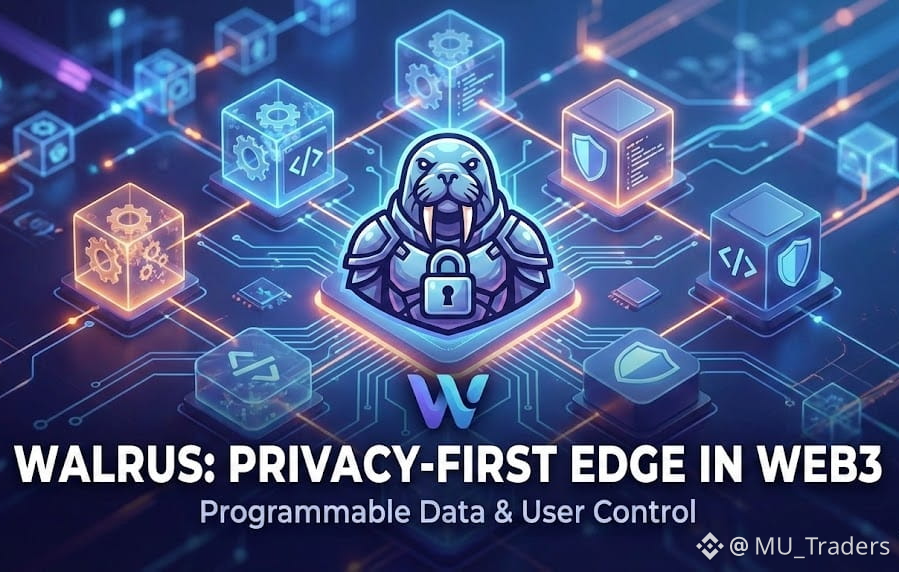
you might think decentralized storage in crypto is a solved infrastructure problem, but Walrus shows how privacy‑controlled data can become a foundational layer for next‑generation applications rather than just another backend utility. Most decentralized storage focuses on permanence or availability. Walrus shifts the conversation toward who gets to see, use, and govern data in a world where transparency and privacy can’t simply be defaults. That nuance matters far more than most realize as Web3 scales. (Walrus)
The Privacy Gap in Decentralized Storage
In many blockchain systems, data stored on public networks is visible to everyone. That openness supports censorship resistance, but it also creates real limits for use cases where controlled access is essential. Imagine decentralized social feeds, encrypted documents, or shared identity credentials. If anyone can read everything, those use cases hit dead ends. Walrus, with the integration of tools like Seal, lets builders enforce fine‑grained access control over encrypted data stored on its network, bridging a gap between openness and privacy in Web3. (Walrus)
This effect matters now because Web3 is no longer just about tokens and contracts. Developers are building applications that look and feel like real software: private messaging layers, enterprise document storage, user profiles, credential systems, and legal records. To be useful, those must protect privacy while remaining verifiable. Walrus’s privacy‑enabled storage means user data isn’t just out there in the open; it’s accessible only to authorized wallets or actors as defined by on‑chain logic. (Walrus)
Programmability Meets Privacy
Another subtle but powerful implication is the way Walrus turns stored content into programmable, permissioned assets. In its model, data blobs and storage rights can be managed through smart contracts on the Sui blockchain. This means you can build access rules, expiration logic, subscription gates, or revocation policies directly into the data itself — not just in an app layer sitting above storage. That elevates storage from a static service to a dynamic part of application logic that respects privacy and ownership at every step. (Walrus)
For instance, an app could automatically revoke access to stored content when a subscription ends, or allow only holders of specific credentials to decrypt a document. These capabilities extend far beyond what traditional decentralized storage systems offer, because those systems mostly treat data as public chunks scattered across nodes. Walrus treats storage as a programmable, rule‑aware resource. (Walrus)
Data Ownership in a Privacy‑Aware Future
In practical terms, this changes how developers think about building user‑centric services on decentralized networks. Privacy‑first storage lets users retain control over their own information without relying on centralized intermediaries to enforce permissions. It merges the ideals of data sovereignty with real‑world use cases that actually require restrictions on who can see and use data. That’s a different kind of ownership than simply controlling a wallet key. (Walrus)
This isn’t just a technical tweak. It’s a shift in how data is treated in decentralized systems — from something open by default to something that can be open, private, or permissioned, depending on user intent and application need. As decentralized apps grow more sophisticated, that flexibility may become one of the most overlooked but important advances in how we build and use blockchain‑based systems. (Walrus)
@Walrus 🦭/acc $WAL #Walrus