Most blockchain systems look strongest at the beginning. Activity is high. Incentives are generous. Nodes are easy to find. Data is replicated everywhere because everyone is paying attention. During this phase, resilience looks effortless. The real test comes later, when usage settles into routine, rewards normalize, and only the participants who truly need the system remain. Walrus is designed for that quieter phase, not for the launch moment.
As blockchain stacks become more modular, responsibilities separate. Execution layers handle computation. Settlement layers provide finality. Applications focus on user-facing logic. Data cuts across all of them and persists far longer than any single layer. When data availability weakens, every other layer inherits risk. Verification becomes harder. Disputes lose clarity. Over time, trust drifts away from code and toward whoever still happens to hold the history. Walrus exists to stop that drift before it starts.
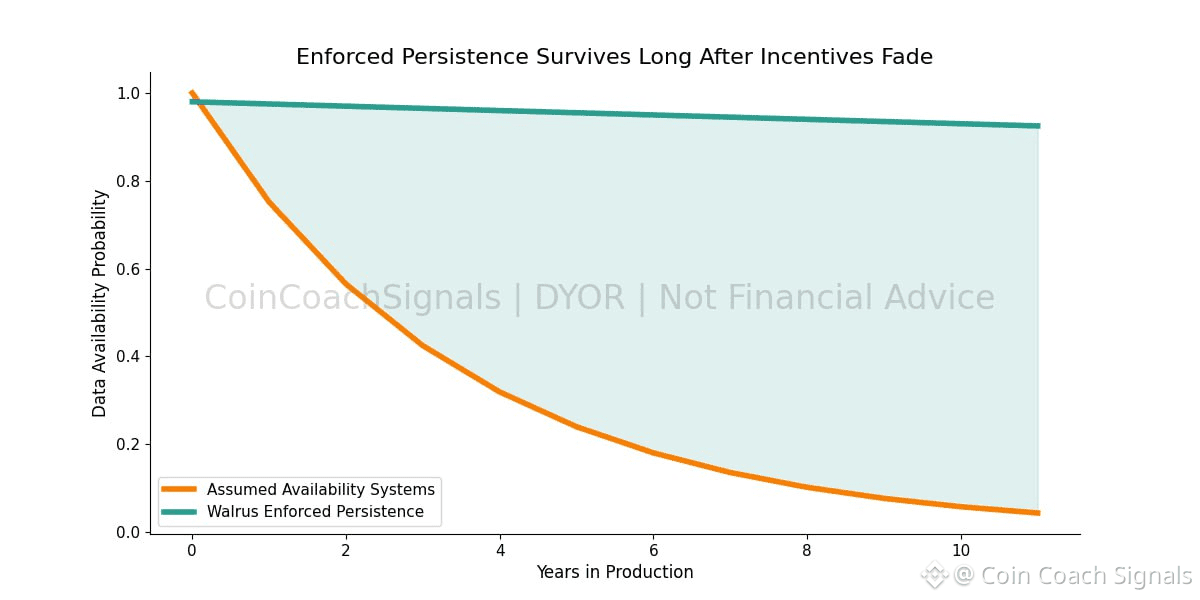
Many systems quietly assume that data will stay available because it mattered once. In practice, importance is temporary. Incentives change. Storage operators leave. What remains is partial history and fragile guarantees. Walrus treats availability as a long-term responsibility, not as a side effect of early interest. The protocol does not rely on hope. It enforces persistence.

Its design allows large data sets to live outside execution environments while anchoring their integrity cryptographically. This keeps base layers from being overwhelmed by storage costs while preserving verifiability. More importantly, it makes accountability explicit. Data is not uploaded and forgotten. It remains available because the system requires it to remain so.
Time is where most weak designs are exposed. Availability is rarely stressed when systems are young. It is stressed years later, when participation thins and incentives weaken. Many networks degrade quietly during this period. Nothing fails outright, but guarantees erode. Walrus is built to resist that slow decay by aligning incentives with continued availability rather than short-term activity.
For rollups and Layer 2 systems, this reliability is foundational. Their security assumptions depend on access to historical data for verification, dispute resolution, and state reconstruction. Without that data, execution correctness becomes impossible to prove. Walrus provides a dependable layer so these systems can assume continuity instead of building fragile contingency paths.
This reflects a security mindset that assumes entropy, not stability. Participants will rotate. Attention will move elsewhere. Incentives will change. Systems that depend on constant engagement eventually weaken. Walrus designs around that reality by making availability resilient to change instead of dependent on ideal conditions.
Decentralization also becomes more tangible through this lens. A network with distributed execution but fragile memory is only partially decentralized. Control over the past concentrates in whoever retains access to history. Walrus strengthens decentralization by keeping historical access distributed and verifiable long after early participants exit.
Economic clarity reinforces this durability. Infrastructure meant to support long-lived systems cannot rely on opaque or volatile cost structures. Builders need to reason about availability over long horizons. Walrus emphasizes predictable economics that support planning instead of constant adjustment. When longevity matters, clarity beats aggressive incentives.
Neutrality is another core characteristic. Walrus does not try to influence how applications are built, how execution layers operate, or how governance decisions are made. It does not compete for users or liquidity. It provides a service that multiple ecosystems can rely on without surrendering control. This neutrality reduces fragmentation and makes broad integration possible.
The builders gravitating toward Walrus reflect this mindset. They are not chasing short-term attention. They are working on rollups, archival systems, and data-heavy applications where losing history is not an option. For these teams, success is defined by absence. No missing data. No broken verification. No silent degradation over time.
There is also a broader shift reinforcing why this matters. As blockchain systems begin to support real economic activity, tolerance for hidden fragility drops sharply. Users may never talk about data availability, but they experience its failure immediately when systems cannot reconstruct state or prove correctness. Mature infrastructure is defined by what keeps working after incentives weaken.
What ultimately characterizes Walrus is restraint. It does not expand beyond its mandate. It does not chase narratives. Each design choice points in the same direction. Preserve data. Make it verifiable. Keep it sustainable over time. That focus does not generate noise, but it builds trust steadily.
In decentralized systems, memory is not a convenience. It is authority. Whoever controls history controls verification. Walrus is building infrastructure that keeps that authority distributed even as networks age and attention fades. That quiet persistence is what allows entire ecosystems to remain credible long after the spotlight moves on.
For educational purposes only. Not financial advice. Do your own research.
@Walrus 🦭/acc #Walrus #walrus $WAL