Walrus shows up in conversations long after the token math and throughput slides stop mattering.
@Walrus 🦭/acc comes up when a team is about to ship something public... a gallery, with metadata that is going to be screenshotted, cached, bookmarked... and treated as permanent by people who will never read your docs. At that point though, storage is less like infrastructure and starts behaving like exposure.
Nobody says that out loud. The release doc just gets an extra hold-step. I have watched that hold step appear even when everything "works", because someone still has to write the word. And yeah, everyone says they have redundancy. Until the first blank tile.
Media libraries and NFT backends do not get treated like DeFi features. There is no upside curve to chase. There's only the downside of being the project whose images 404, whose attributes mutate, whose content 'temporarily' disappears and then never quite comes back the same way. That kind of failure doesnot trigger a liquidation. It triggers screenshots to be honest.
Teams who will tolerate flaky RPCs or occasional latency get strict in a different way. The room stops asking about cost and starts watching the first marketplace cache showing blanks. Nobody cares what your dashboard says. They care what the cache shows. That thread lasts weeks.
The cache is what they see. And what they see becomes the story.
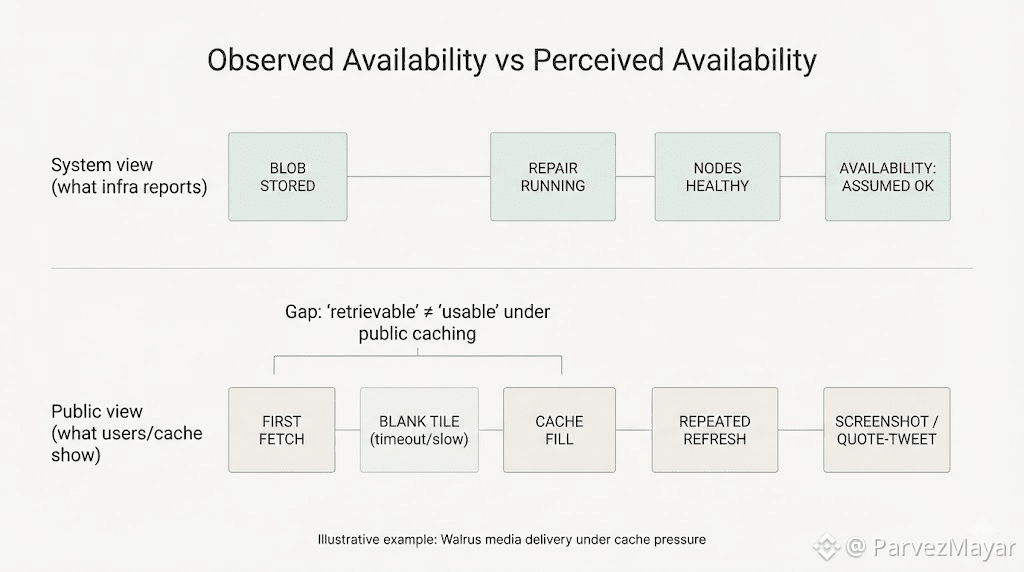
Walrus shows up right when "probably fine' stops being defensible. Big objects, real fetches... and an availability window you paid for that does not care about your launch calendar. Pieces drift, repairs keep running in the background, and your blob still has to come back clean. If you put something there and point users at it, it stays pointed through churn, epoch turns, all of it.
If retrieval slips... you don't get to wave it off as "just a cache issue"'. Everything looks "green" until someone refreshes twice, gets a spinner and posts it. That is when 'reconstructible' turns into "why is this taking so long right now," and nobody in the room is interested in the internal story.
When media slips, the failure is visible before it's measurable. If a yield strategy underperforms, users leave quietly. If media disappears, people notice loudly. The first cost isn't the bill. It is the quote-tweets.
You can feel teams responding before anyone admits it's a response. They overbuild the storage path. Redundancy they dont strictly need. Access controls tighter than UX would prefer. Extra checks that slow things down but make postmortems survivable. The path can be technically fine and the ticket still won't move, because 'retrievable' and "usable" are not the same sentence when the app is public.
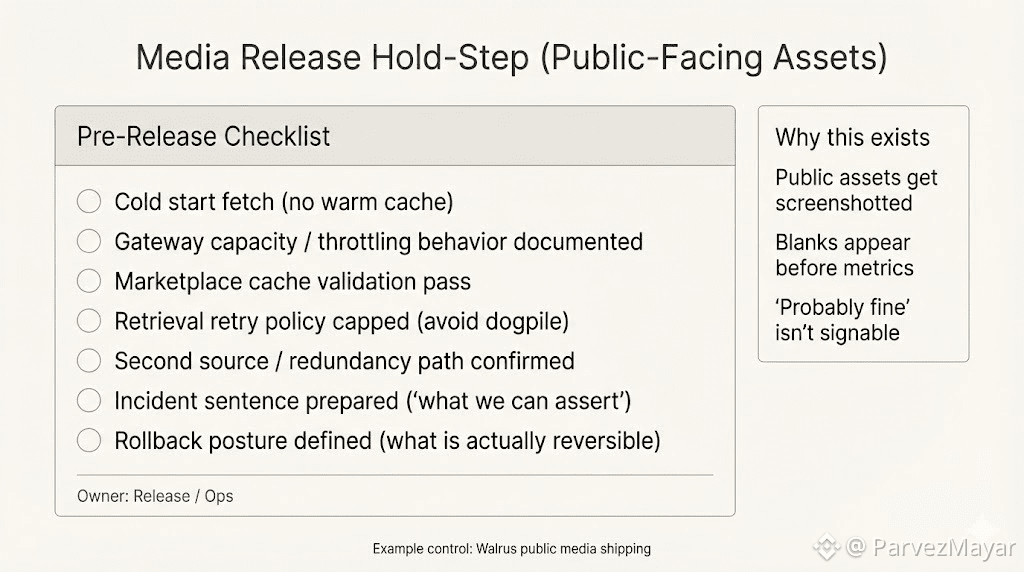
So the boring stuff shows up early. Holds, checklists... a second copy nobody admits is there, and rules about what's allowed on the critical path. Store less than the product wants, because the failure mode is too loud.
Walrus will not save you. It just makes the commitment harder to dodge once you've pointed users at it.
The hold-step stays in the doc. Waiting for the first time the tile doesn't load. #Walrus $WAL