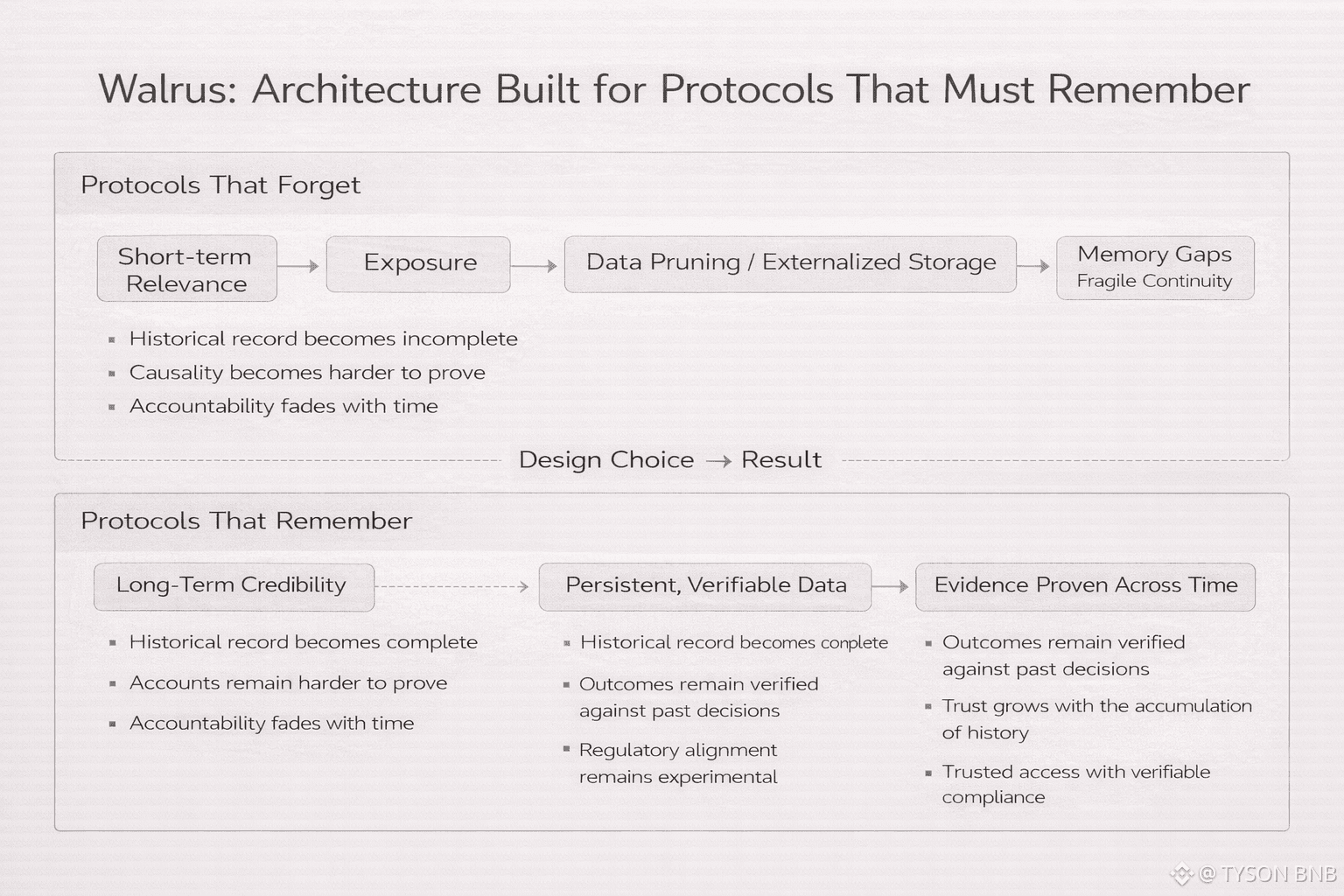
 As protocols mature, their most valuable asset is no longer speed or throughput. It is memory. Serious protocols do not just execute transactions; they accumulate history. State transitions, proofs, governance actions, checkpoints, and outcomes form a continuous record that defines what the protocol is. For systems that coordinate value, security, or shared truth, forgetting is not a neutral failure. It is an existential one. Protocols that must be trusted over years are, by definition, protocols that must remember.
Yet much of today’s infrastructure is designed as if memory were optional. Storage is treated as an accessory, optimised for cost or convenience rather than continuity. Once data stops being immediately useful, it gets archived, pruned, or externalised. Herein lies the contradiction: protocols demand long-term credibility, but their architectures assume short-term relevance. We expect systems to defend past decisions, but we build them on foundations that quietly discard the evidence.
The risk of forgetting compounds over time. When historical data becomes fragmented or unavailable, protocols lose the ability to explain themselves. Disputes cannot be resolved cleanly. Upgrades become harder to justify. Accountability weakens because causality blurs. This risk is further enhanced in the decentralized environments. If memory is dependent on changing incentives or off-chain services, then continuity becomes fragile. A protocol that cannot reliably access its own past is forced to operate on trust assumptions it cannot verify.
Walrus is built around a different architectural assumption: some protocols cannot afford to forget. Instead of optimizing storage as a peripheral layer, Walrus treats durable data availability as a core primitive. Its architecture favors durability, verifiability, and resilience through time rather than merely availability within the current moment. Data is not merely saved; it is placed on a footing where its removal, quiet modification, or extinction would be highly problematic.
This impacts the evolution of the protocol. Memory is no longer an operational burden to manage, but a reliable constant. Protocols can grow, upgrade, and adapt without severing their connection to prior states. Decisions remain traceable. Proofs remain checkable. History remains accessible not because someone maintains it, but because the system is built to preserve it.
The long-term truth is that decentralization without memory is incomplete. Protocols that aim to outlive teams, narratives, and market cycles must be able to carry their past forward intact. Trust over time is not created by promises of permanence, but by architectures that assume permanence as a requirement.
Walrus does not frame remembrance as a feature for edge cases. It treats it as a baseline for serious protocols. In an ecosystem where forgetting is often invisible until it causes failure, building systems that remember by design is not conservative. It is necessary. Protocols that must matter tomorrow need architectures that refuse to forget today.