The field of decentralized finance (DeFi) is rapidly growing to include identity management, data storage, and safe communication with decentralized apps in addition to financial transactions. In this regard, the Walrus protocol, which makes use of the sophisticated technical infrastructure of the Sui network, stands out as a creative approach meant to handle the issues of decentralized storage, anonymity, and scalability. The Walrus protocol and its native token, WAL, are thoroughly examined in this paper. Its design, security and privacy features, governance model, and potential to redefine decentralized data storage for decentralized businesses and applications are all highlighted.
1. Overview
Because traditional cloud storage depends on centralized organizations managing data, there are hazards associated with censorship, privacy violations, and single points of failure. Many initiatives to provide decentralized alternatives have surfaced as blockchain technology has developed, but the majority have encountered issues with cost, performance, or poor integration with already-existing decentralized applications.
These issues are directly addressed by the Walrus protocol, which leverages the Sui network's high performance and parallel processing capabilities while attempting to integrate decentralization, anonymity, and economic efficiency into a unified framework.
2. Overview of the Walrus Protocol
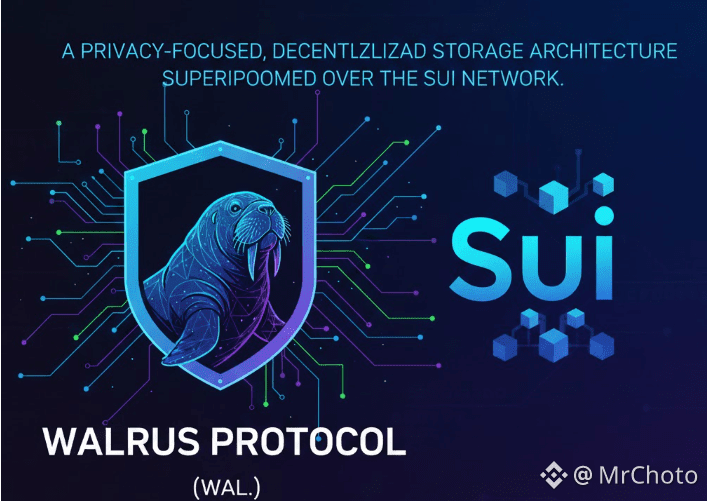
Walrus is a decentralized storage and transaction protocol designed to give users and applications the ability to store and interact with data in a way that is both privacy-preserving and resistant to censorship. In the DeFi ecosystem, it supports safe interaction mechanisms, governance, and decentralized applications in addition to storage.
Instead of storing data in one place, the protocol uses a network of independent nodes to distribute information, which lowers the possibility of loss or tampering and boosts system reliability.
3. Dependency on the Sui network and technical architecture
Walrus is based on the Sui blockchain, a network renowned for its low latency and ability to execute transactions in simultaneously. The Walrus protocol can retain decentralization while achieving excellent performance because to this decision.
Walrus divides big files into smaller portions that are spread across several nodes by combining block storage and erasure coding techniques. This method improves robustness and reliability by enabling data reconstruction even in the event that some components are destroyed.
34. Data security and privacy
A key component of Walrus' design is privacy. The protocol uses sophisticated encryption techniques to ensure that only authorized parties can access data, rather than keeping raw data. Distributing data within a decentralized network also lessens the possibility of systematic spying or surveillance.
This strategy helps make Walrus appropriate for sensitive applications where privacy is crucial, such digital identity management, medical data storage, or company records.
5. The economic significance of the WAL symbol
The native cryptocurrency of the Walrus ecosystem, the WAL token serves a number of crucial purposes, such as:
Pay costs for network usage and storage.
The agreement promotes involvement in resource provision.
taking part in protocol development governance and decision-making processes.
This economic model is an effort to lessen dependency on centralized organizations while striking a balance between financial incentives and network resilience.
6. Decentralized administration
WAL token holders can propose and vote on updates and major protocol modifications thanks to Walrus's governance approach. This system seeks to maintain enough flexibility to keep up with technology improvements while ensuring that the project changes in accordance with the desires of the community.
7. Potential applications and use scenarios
Numerous use cases are made possible by the Walrus protocol, including:
hosting decentralized apps that need scalable and safe storage.
decentralized substitutes for conventional cloud services.
keeping private company information.
support for DeFi protocols, which demand great transaction secrecy.
8. Difficulties and constraints
Walrus may have difficulties despite its technological benefits, including:
the technical infrastructure's complexity in contrast to centralized solutions.
the requirement for developers to embrace it more widely.
rivalry with alternative decentralized storage systems.
Resolving these issues is still essential to the protocol's long-term viability.
In conclusion
By combining scalability, efficiency, and anonymity into a single architecture, the Walrus protocol is a genuine attempt to rethink decentralized storage. It is positioned to support a new generation of decentralized apps thanks to its strong technical foundation, which is provided by its reliance on the Sui network and its use of cutting-edge technologies like erasure tokenization. However, Walrus's success will mostly rely on its capacity to attain broad acceptance, create a thriving development and user community, @Walrus 🦭/acc #walrus $WAL