For a long time, “privacy” in crypto meant one thing: disappear and hope no one asks questions.
That worked in the early days. It doesn’t work anymore.
As blockchains try to move closer to real finance -- securities, institutions, regulated markets, the rules change. Privacy is still essential, but it can’t be absolute. Systems need to explain themselves. Transactions need to be provable. When something goes wrong, the chain can’t just shrug.
This is the world Dusk is building for.
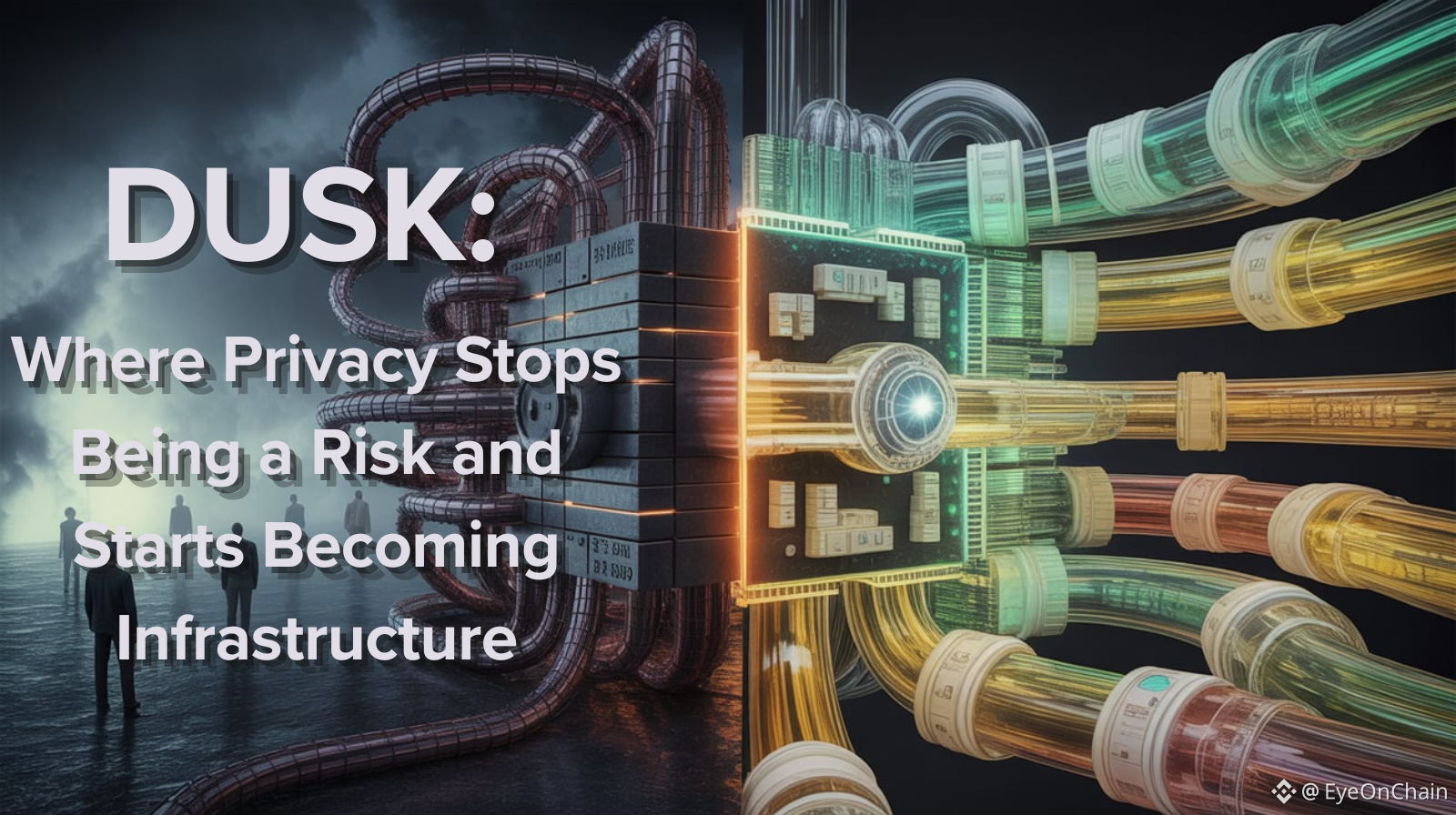
As Dusk shifts into a modular architecture, it introduces Hedger, a new privacy engine that lives directly inside the EVM execution layer. Not wrapped around it. Not bolted on. Inside it.
Hedger brings confidential transactions to DuskEVM in a way that feels… grounded. It blends homomorphic encryption with zero-knowledge proofs, creating a system where values can stay hidden while still being used, verified, and audited. The result isn’t “mystery privacy.” It’s compliance-ready privacy. The kind real financial systems can actually use.
What makes Hedger different is where it lives.
Earlier systems like Zedger were designed for UTXO-based worlds, where anonymity is native but composability is hard. Hedger is built for the account-based reality of the EVM. It speaks Ethereum’s language. It plugs directly into standard tooling. Developers don’t have to relearn everything. Institutions don’t have to rebuild their entire stack. It’s familiar, scalable, and auditable from day one.
Under the surface, Hedger is less about one clever trick and more about balance.
Most DeFi privacy tools rely entirely on zero-knowledge proofs. Hedger doesn’t put all its weight on a single pillar. It layers cryptography. Homomorphic encryption allows computations on encrypted values, so data doesn’t need to be exposed just to be useful. Zero-knowledge proofs confirm that everything happened correctly, without revealing what “everything” actually was. A hybrid UTXO and account model keeps the system flexible across layers and compatible with real financial workflows.
It’s not trying to be magical. It’s trying to be dependable.
That design unlocks things blockchains have struggled with for years.
Order books can finally be obfuscated. Large traders no longer have to broadcast intent to the entire market. No more advertising size, timing, or exposure to anyone watching. That alone reshapes what institutional trading can look like on-chain.
Asset ownership becomes confidential. Balances stay encrypted. Transfers don’t leak meaning. Yet when regulation demands clarity, the system can answer. Transactions are auditable by design. Not “trust us” auditable. Cryptographically provable.
And it doesn’t come at the cost of usability.
Proofs can be generated directly in the browser in under two seconds. No ritual. No long pauses. No broken flow. You click, you move on. The chain keeps up.
Now, there’s a trade-off. The EVM’s account model will never offer perfect anonymity. Zedger still holds that edge. Hedger chooses a different path: full transactional privacy inside an ecosystem the world already uses. Better performance. Cleaner architecture. Seamless compatibility.
That choice is deliberate.
Hedger isn’t built to escape reality. It’s built to work inside it.
Developed in-house, shaped by years of applied cryptography, it reflects real constraints: regulators exist, developers need clarity, users expect speed. It’s privacy engineered for adulthood.
And that’s why it matters.
Because real finance doesn’t live in the shadows. It lives in a space where discretion and accountability coexist. Where strategies are private, but outcomes are verifiable. Where dignity doesn’t mean opacity.
Hedger becomes a foundation for that world. A layer where financial applications can operate privately, compliantly, and at scale. Not as an experiment. As infrastructure.
This is what $DUSK is building toward. Not a loophole. Nor a rebellion. A chain that fits the world it’s meant to serve.
@Dusk #Dusk
Disclaimer: Thoughts are our own, not a financial advice . Always DYOR twice before any investment decisions.