Late night here in Peshawar sifting through recent Sui Stack mentions and the January 8 2026 Seal whitepaper release keeps coming back as a quiet signal of where things are heading. Walrus stands out as the piece addressing the tension we have all felt: chains deliver instant verifiable logic yet data itself often lingers on borrowed time from centralized hosts or fragile integrations. It uncovers an architectural oversight that has forced builders to accept impermanence in the one area where permanence matters most.
THE REAL PROBLEM
Blockchains optimize for replicated execution on compact state but large unstructured blobs push costs beyond practicality when replicated across validators. This forces a compromise: accept inefficiency onchain or offload to external services reintroducing trust assumptions and availability risks that undermine the decentralized model. The result is a system technically robust in computation but technically incomplete in sustaining the data that feeds it over time.
WHAT WALRUS IS
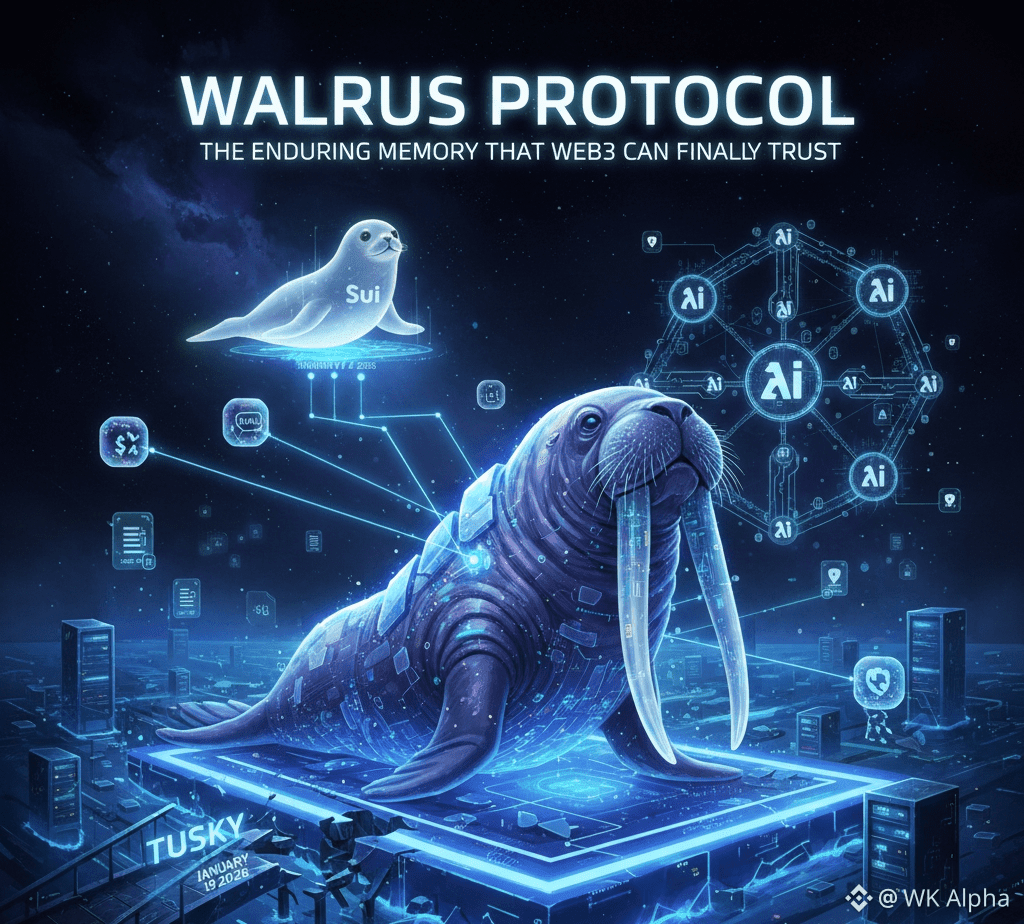
Walrus serves as a decentralized storage and availability layer using erasure coding to shard blobs across nodes with low replication typically four to five times for efficient durability. It maintains long term memory through cryptographic proofs and node challenges that verify presence without full downloads. The engineering purpose centers on reliable retention as illustrated by the Tusky migration deadline of January 19 2026 where users must move files to Walrus blobs to preserve decentralized access after the front-end ends.
WHY SUI MAKES SENSE
Suis object centric architecture models resources as programmable which aligns perfectly with Walrus blobs as attestable objects carrying onchain metadata and proofs. Sui handles payments governance and coordination while Walrus distributes the storage burden keeping the execution layer uncluttered. This complementarity enables seamless use cases like Seal from January 8 2026 where Walrus stores encrypted payloads for programmable privacy in AI and compute.
DATA AS INFRASTRUCTURE
Durability of data should be a protocol enforced responsibility not an add on service prone to failure. Walrus embeds this with epoch based node obligations staking for accountability and incentives tied to uptime performance. The Tusky scenario reinforces it: decentralized storage outlives front-ends turning data into reliable infrastructure for applications that need persistence beyond short cycles.
ROLE OF $WAL
$WAL acts as the structural element covering storage fees node staking and governance votes on parameters such as epoch durations or cost curves. It spreads payments across periods for stable operator incentives while usage burns link economics to real demand. The token commits to long term network health through utility and security alignment rather than narrative speculation.
WHAT WALRUS IS BECOMING
Walrus does not position against centralized clouds or broad execution chains but settles in as the memory layer that AI agents privacy protocols and data markets depend on for verifiable longevity. With Sui Stack integrations like Seal and migration support it enables information to persist across ecosystems. In these still moments WalrusProtocol feels like the grounded foundation that lets decentralized data finally hold its own.