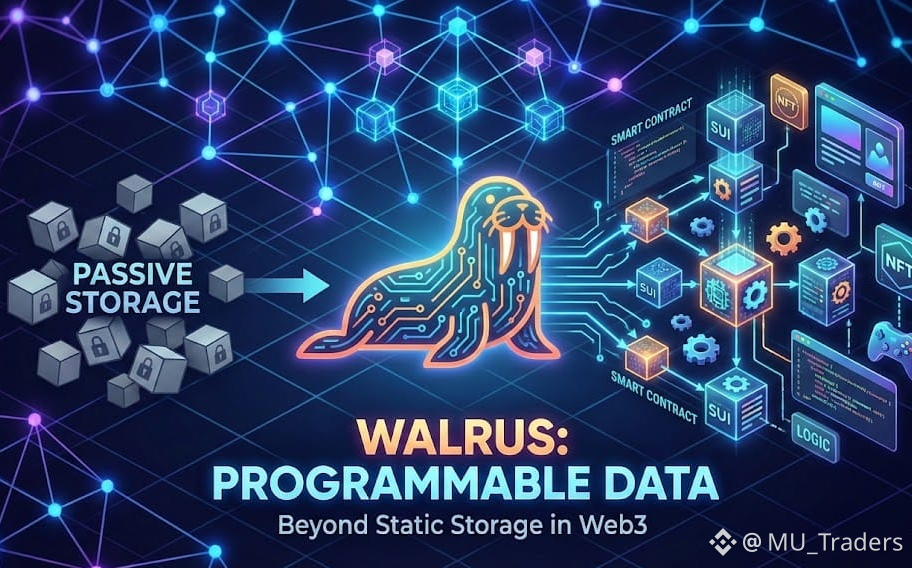
you may have read about decentralized storage in crypto and assumed that all of these solutions do basically the same thing: scatter files across nodes and hope they stay safe. Walrus challenges that assumption by treating data as a programmable resource rather than just a static blob sitting on a server. Instead of simply storing files, Walrus makes them first‑class actors in blockchain applications, deeply integrating storage with logic and smart contracts in ways few other protocols do. That shift might be subtle at first glance, but it could fundamentally change how decentralized apps handle data. (Superex)
From Passive Storage to Active Resources
Traditional decentralized storage networks focus on redundancy and availability. They pull data away from centralized control and make it accessible across a distributed network. Walrus builds on that foundation, but it goes further by embedding storage into the programmable environment of the Sui blockchain. When a file (or “blob”) is uploaded to Walrus, it isn’t just scattered around storage nodes and forgotten. Instead, it gets represented as an on‑chain object with metadata and lifecycle traits that can be referenced directly by contracts and applications. This means developers can automate how data behaves based on logic on the blockchain, such as renewing storage, enforcing access conditions, or linking files to tokenized assets. (Walrus)
In practical terms, storage on Walrus becomes something composable within Web3 ecosystems rather than an external utility. An NFT project could link high‑resolution art to a blob on Walrus and programmatically control access rights or expiration. A decentralized game could manage large assets in ways that react to in‑game events, because the storage itself participates in the logic layer. These are use cases where data isn’t just stored; it’s part of the application’s state and behavior. (Superex)
Why Sui Makes a Difference
The reason Walrus can do this lies in how it integrates with the Sui blockchain. Sui’s object model and Move‑based smart contract environment allow non‑fungible resources and metadata to be represented directly on chain. Walrus uses this model to track storage objects and proofs of availability, meaning smart contracts can own, transfer, or interact with these data representations as native objects. Rather than storing large files on chain (which is prohibitively expensive), Walrus only writes lightweight metadata and proofs to Sui, keeping costs reasonable while preserving verifiable continuity and programmability. (Walrus Docs)
This integration also opens the door for multi‑chain or cross‑ecosystem use. Although Walrus lives on Sui for control and coordination, its storage tools and interfaces make it possible for developers on other blockchains to leverage Walrus’s programmable storage layer. That’s a subtle but important distinction: Walrus isn’t just a siloed storage silo bound to one network, it can be a shared resource across Web3 stacks. (Walrus)
Implications for Web3 Builders and Users
When data becomes programmable in this way, it unlocks new architectural possibilities. Instead of separating data logic from application logic, builders can embed rules for data lifecycle, access, and interaction directly into distributed systems. By bridging storage and smart contracts, Walrus makes data an active player in app workflows. That’s a shift from merely storing information to orchestrating how it’s used, governed, and evolved within decentralized ecosystems.
Over time, this architectural shift may influence how decentralized identity systems store credentials, how decentralized social platforms handle user‑generated content, and even how data feeds into AI or dynamic NFT experiences. Walrus’s focus on programmability and native integration with blockchain logic is more than an incremental improvement in storage. It’s a rethinking of data’s role in Web3 systems, and that’s an angle worth paying attention to as the ecosystem matures.
@Walrus 🦭/acc $WAL #Walrus